
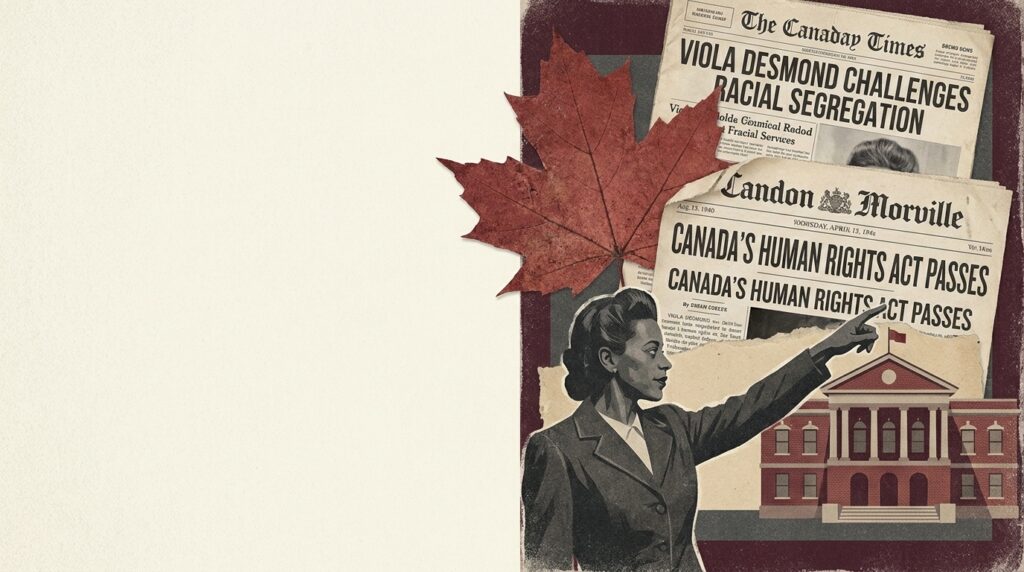
Canada is often portrayed as a model of tolerance. But the legal history of Black Canadians tells a different story — one of systematic exclusion, deliberate resistance, and hard-won rights. The following milestones represent the most significant turning points in that legal and civil journey.
Canadian history often highlights multicultural harmony. However, the path to justice required intense struggle. Black Canadians fought colonial enslavement. They dismantled mid-century segregation. They rewrote constitutional frameworks. This activism challenged systemic racism directly. These milestones reveal the true evolution of civil rights. They define modern criminal justice reform.
The Civil Rights Landscape (Historical Pillars)
To understand this journey, researchers point to verified digital registries. You can trace early legal battles via The Canadian Encyclopedia Historical Timelines. Furthermore, operational documentation regarding modern structural overhauls and community-driven initiatives remains accessible through The Government of Canada Black History Frameworks.
ه
1. The Abolition Era and Early Legal Resistance
Early Canadian justice focused heavily on liberation struggles. Enslaved individuals actively challenged colonial structures. Freedom seekers pioneered complex legal defense strategies. Their efforts gradually forced judicial transformations. This era laid foundation stones for constitutional equality.
Milestone Breakdown: Abolition Timeline
Detailed analysis of these structural shifts remains preserved in permanent archives. Researchers can investigate precise statutory provisions through The Slavery Abolition Legislation Studies. Additionally, comprehensive geographic data highlighting freedom settlement points is managed via The Historic Black Canadian Settlements Registry.
2. Desegregation and the Mid-Century Civil Rights Surge
The mid-20th century marked a critical pivot. Black Canadians intensified their systematic legal battles. Racial segregation was widespread in public spaces. Grassroots coalitions targeted discriminatory business policies. Activists strategically challenged systemic employment biases. Courts slowly began penalizing explicit commercial discrimination. These localized movements forced provincial legislatures to intervene. They built essential legal momentum for national human rights codes.
Milestone Breakdown: Mid-Century Legislation
Official historical records map these progressive statutory protections. The complete judicial narrative of mid-century desegregation stands fully archived on The Canadian Encyclopedia Viola Desmond Case Studies. For verified legislative texts and early human rights frameworks, researchers can consult The Ontario Human Rights Commission Historical Archives. Furthermore, detailed regional accounts are compiled within The Canadian Museum for Human Rights Exhibits.
3. Political Breakthroughs and Constitutional Protections
The late 20th century transformed Canadian federal governance. Black leaders successfully breached historic electoral barriers. Student-led resistance movements exposed deep institutional biases in academia. Federal lawmakers recognized the necessity of unified human rights frameworks. Courts received explicit, binding anti-discrimination mandates. Constitutional restructuring forever changed systemic litigation nationwide. These hard-won legal changes permanently fortified institutional protections for minorities.
Milestone Breakdown: Constitutional Progress
Official parliament and constitutional registries preserve these major legal shifts. The complete legislative impacts of Section 15 can be reviewed via The Department of Justice Charter Directory. To trace federal political histories and Lincoln Alexander’s parliamentary record, visit The Parliament of Canada Heritage Profiles. For documentation regarding academic civil rights movements, consult The Sir George Williams Archives on The Canadian Encyclopedia.
4. Modern Justice Reform and Systemic Overhauls
The current decade centers on dismantling systemic anti-Black over-policing. Mass mobilizations forced historic administrative action. Expert advisory steering groups submitted radical institutional policy overhauls. Federal legal bodies mandated comprehensive updates to criminal codes. Police forces face strict structural accountability parameters. National strategies actively target generational incarceration disparities. These combined efforts seek permanent equitable transformation across Canada’s legal system.
Milestone Breakdown: Modern Frameworks
Official federal resources outline these legislative strategies and implementation phases. Review the extensive technical pillars and action plans directly via The Government of Canada Black Justice Strategy Portal. To assess the independent legal recommendations submitted by the expert steering group, consult The Justice Canada Reform Reports.
Conclusion: The Work Ahead
The history of Black Canadian civil rights reveals continuous determination. True equity demands vigilant enforcement of legislative frameworks. These legal milestones are more than historical footnotes. They provide the practical blueprint for Canada’s ongoing judicial evolution.
Official Civil Rights Repositories & Legal Databases
Deepen your academic research with verified federal portals. These statutory entities monitor modern systemic equity initiatives. They maintain complete legal records of constitutional developments.
Deep Dive: The Abolition Era and Legal Precedents
The legal battles began long before confederation. Enslaved populations in Upper Canada utilized early courts. They challenged the explicit property rights of loyalist slaveholders. Chloe Cooley’s violent resistance in 1793 forced immediate legislative reactions. Lieutenant-Governor John Graves Simcoe witnessed her forced sale. He used this event to introduce institutional limitations. The resulting Act to Limit Slavery did not grant immediate freedom. However, it prevented the further introduction of enslaved persons. It mandated that children born to enslaved mothers became free at age 25. This incremental legal strategy created a distinct judicial path. It eroded the statutory legitimacy of human bondage regionally.
By 1833, British imperial pressure forced absolute changes. The Slavery Abolition Act completely restructured colonial property laws. It redefined individual civil status across British North America. Following this statutory shift, Canada became a geographic sanctuary. The Underground Railroad operated as a highly coordinated legal evasion network. Vigilance committees managed secret safe houses. Black refugees faced intense economic exclusions upon arrival. Yet, they successfully built organized legal communities. They established churches, independent schools, and municipal councils. Dawn Settlement and Elgin Settlement served as economic models. These communities proved Black self-governance capabilities. They directly countered pervasive white supremacy arguments of that era.
Historical documentation of Chloe Cooley’s case remains preserved. Scholars can access the original Executive Council minutes via The Archives of Ontario Government Collection.
Deep Dive: Mid-Century Desegregation and Court Battles
Racial segregation in Canada operated outside explicit apartheid statutes. Instead, private business owners utilized property rights to exclude Black patrons. This de facto segregation faced massive community resistance after World War II. Viola Desmond directly challenged this systemic practice in New Glasgow. She refused to sit in the segregated balcony section of the Roseland Theatre. Her subsequent arrest was masked as tax evasion over a single penny difference. Desmond refused to accept the corrupt lower court ruling. She launched a systemic appeal to the Supreme Court of Nova Scotia. Her legal team exposed how corporate policies weaponized licensing laws to enforce racial containment.
The provincial supreme court ultimately dismissed her case on narrow technicalities. However, the political fallout sparked widespread constitutional debates. Activists in Ontario mobilized immediately to prevent similar judicial failures. Organized labor groups joined Black civil rights coalitions. They pressured the provincial government to establish definitive statutory protections. This massive grassroots lobbying produced the Racial Discrimination Act of 1944. It also secured the Fair Accommodation Practices Act of 1954. These pioneering statutes removed the legal ambiguities private owners exploited. They established the groundwork for Canada’s modern human rights commissions.
Visual Flowchart: The Desmond Case & Legislative Shift
The official executive pardon and legal history of this case are preserved by the state. Researchers can review the formal records via The Nova Scotia Archives Official Historical Database.
Deep Dive: Political Breakthroughs and Constitutional Entrenchment
The federal legislative arena remained largely inaccessible until 1960. Prime Minister John Diefenbaker introduced the Canadian Bill of Rights to establish a unified statutory baseline. This document marked a major philosophical shift in Canadian jurisprudence. However, its effectiveness remained heavily limited because it was not constitutionalized. It applied strictly to federal jurisdictions and lacked the power to invalidate conflicting provincial statutes. Despite these limitations, it gave civil rights lawyers a vital statutory tool to challenge administrative racism. Black communities leveraged this new legal landscape to increase structural political mobilization nationwide.
Political representation reached a historic milestone in 1968. Lincoln Alexander won his seat in the House of Commons representing Hamilton West. As the first Black Member of Parliament, he systematically challenged institutional employment biases within federal departments. He used his legislative platform to advocate for explicit equal opportunity mandates. Simultaneously, grassroots student movements were exposing systemic academic biases. Racial tensions escalated dramatically within Canadian higher education institutions over corporate and administrative indifference.
★ Historical Spotlight: The 1969 Sir George Williams Affair
Six Caribbean students at Sir George Williams University (now Concordia) accused a biology professor of systemic racial grading biases. After institutional channels failed to investigate, students occupied the computer center for 14 days. The occupation ended in a violent police intervention and millions in damages. This event permanently shattered the myth of Canadian racial exceptionalism and forced universities across Canada to rewrite their institutional anti-discrimination policies.
The ultimate judicial transformation occurred in 1982 during the patriation of the Constitution. The entrenchment of the Canadian Charter of Rights and Freedoms fundamentally altered civil litigation. Section 15 of the Charter introduced explicit guarantees of equality before and under the law. Crucially, Section 15(2) permitted affirmative action programs to correct historical disadvantages. This constitutional provision prevented conservative legal challenges from dismantling systemic diversity initiatives. Black legal coalitions now possessed a supreme constitutional weapon to invalidate discriminatory provincial regulations directly through the Supreme Court.
The complete constitutional text and legal annotations for Section 15 are fully accessible online. Researchers can consult The Justice Laws Website Constitutional Directory. For an extensive academic breakdown of the 1969 student protests, review The Concordia University Institutional Archives.
Abolition & Resistance Era
The foundational phase focused heavily on dismantling human bondage. Legal activism led by pioneers slowly dissolved institutional slavery, transforming Canada into a primary destination for global refugees seeking absolute safety.
These three milestones indicate that progress is never mechanical. True equity requires continuous statutory refinement, transparent community evaluation, and constitutional entrenchment.
Bridging the Eras: While modern judicial frameworks focus extensively on criminal law and institutional policing updates, the historical concept of justice for Black Canadians cannot be evaluated strictly within courtroom walls. To comprehend the full scope of anti-Black systemic exclusion, the investigation must pivot backward to examine a dark chapter of geographical and environmental degradation that transformed generational municipal planning.