
Quick answer: Maya Angelou (1928–2014) was an American author, poet, memoirist, and civil rights activist best known for her 1969 autobiography “I Know Why the Caged Bird Sings.” A close associate of Dr. Martin Luther King Jr. and Malcolm X, she later became the first Black woman to write and recite a poem at a U.S. presidential inauguration, delivering “On the Pulse of Morning” for President Bill Clinton in 1993. She received the Presidential Medal of Freedom in 2011.
8 Amazing Facts About Maya Angelou’s Life
- She stopped speaking for almost 5 years as a child. After surviving a sexual assault at age seven, Angelou fell mute, believing her words had caused a man’s death. She spent those years memorizing poetry and literature, which she credits with shaping her love of language.
- She was a single teenage mother. Angelou gave birth to her son, Guy, at age 17, while working a series of jobs — including as a cook, streetcar conductor, and nightclub dancer — to support him before her writing career began.
- She worked alongside Dr. Martin Luther King Jr. In the early 1960s, she served as the Northern Coordinator for his Southern Christian Leadership Conference (SCLC), organizing major fundraising events in Harlem.
- She lived and worked in Egypt and Ghana. Angelou was an editor for an English-language newspaper in Cairo and later worked as a journalist in Accra, becoming part of a community of Black American expatriates supporting African independence movements.
- She was the first Black woman to read a poem at a U.S. presidential inauguration. In 1993, she delivered “On the Pulse of Morning” for President Bill Clinton — the first poet to read at an inauguration since Robert Frost in 1961.
- She won three Grammy Awards — all for Best Spoken Word Album, including for her inauguration poem recording.
- She directed a major Hollywood film. In 1998, Angelou directed Down in the Delta, becoming the first Black woman to direct a studio feature film.
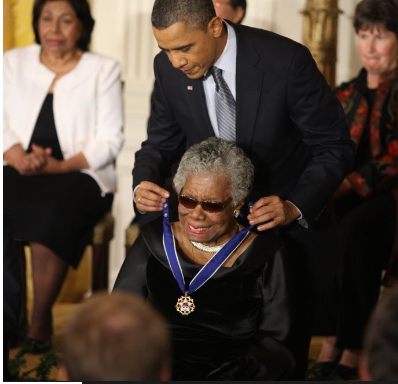
- She received the Presidential Medal of Freedom. President Barack Obama awarded her America’s highest civilian honor in 2011, and in 2015 the U.S. Postal Service issued a commemorative stamp in her honor.
Maya Angelou was born Marguerite Annie Johnson on April 4, 1928, in St. Louis, Missouri. When her parents’ marriage collapsed, three-year-old Angelou and her older brother Bailey were sent by train, wearing tags identifying them to conductors, to live with their paternal grandmother, Annie Henderson, in the small segregated town of Stamps, Arkansas. Their grandmother ran the only general store owned by a Black family in town, and it was there that young Angelou first witnessed both the daily humiliations of Jim Crow segregation and the quiet dignity and resourcefulness of her community. Detailed biographical background is preserved by the Library of Congress.
At age seven, during a temporary stay with her mother in St. Louis, Angelou was sexually assaulted by her mother’s boyfriend, Freeman. After she testified against him in court, he was murdered days later, reportedly by her uncles. The trauma of the assault, compounded by the belief that her words had caused a man’s death, led young Angelou to stop speaking almost entirely for nearly five years. She later described this period of self-imposed silence as the time she fell in love with language — memorizing Shakespeare, Edgar Allan Poe, Georgia Douglas Johnson, and the entire canon of Black poets available to her, reciting them silently to herself until she felt safe enough to speak aloud again. This account is documented in academic literary biographies held by the Poetry Foundation.
Literary Breakthrough: I Know Why the Caged Bird Sings
Angelou’s defining work, I Know Why the Caged Bird Sings, was published in 1969 at the encouragement of author James Baldwin and editor Robert Loomis, who reportedly convinced her to write an autobiography by suggesting it was nearly impossible to write autobiography as literary art — a challenge Angelou could not resist. The book recounted her childhood in Stamps, the trauma of her assault, and her adolescence in California, including becoming a teenage mother, with a level of candor almost unheard of in mainstream American publishing at the time.
The book was nominated for a National Book Award in 1970 and is widely credited with helping open the door for a generation of Black women memoirists, including Alice Walker and Terry McMillan. It has also remained one of the most frequently challenged and banned books in American public schools for decades, a status tracked annually by the American Library Association’s Office for Intellectual Freedom, which lists it among its most-challenged classics due to its depictions of racism, sexual abuse, and teenage pregnancy.
Over the following three decades, Angelou expanded her autobiography into six additional volumes — including Gather Together in My Name (1974) and The Heart of a Woman (1981) — tracing her life from young adulthood through her international travels, activism, and eventual literary fame. This made her one of the few American writers to document an entire adult life across a continuous multi-volume autobiographical series.
Poetry and Recognition
Alongside her memoirs, Angelou published numerous acclaimed poetry collections. Just Give Me a Cool Drink of Water ‘fore I Diiie (1971) earned her a Pulitzer Prize nomination, establishing her as a major poetic voice distinct from her prose work. Her poetry frequently addressed themes of resilience, racial identity, and womanhood, drawing on oral traditions from both African American church culture and West African storytelling she encountered during her years abroad. A full catalog of her published poetry collections is maintained by the Poetry Foundation.
Civil Rights Work and Life Abroad
In the early 1960s, Angelou moved to New York and became active in the civil rights movement at the urging of civil rights leader Bayard Rustin. She was appointed Northern Coordinator for Dr. Martin Luther King Jr.’s Southern Christian Leadership Conference (SCLC), organizing fundraising events such as “Cabaret for Freedom” in Harlem, which she co-wrote and co-produced with comedian Godfrey Cambridge, to support the movement’s expansion beyond the American South.
Following the assassination of her close friend Malcolm X in February 1965, and having lived for a period in Cairo with her then-partner, a South African freedom fighter, Angelou relocated to Accra, Ghana. There she worked as a features editor for the African Review and as a freelance writer for the Ghanaian Times, becoming part of a prominent community of Black American expatriates — including author Julian Mayfield — who supported Kwame Nkrumah’s Pan-African independence movement. She had earlier lived in Cairo, Egypt, working as an associate editor for the English-language weekly The Arab Observer, making her one of the few Western women, and the only known Black American woman, to hold an editorial post in the Arab press at that time. This period profoundly shaped her later writing on exile, diaspora, and Black identity beyond U.S. borders, and is discussed in official retrospectives by PBS American Masters.
The 1993 Inauguration and National Recognition
Angelou’s national profile expanded dramatically in January 1993, when President-elect Bill Clinton personally invited her to compose and deliver an original poem at his inauguration. Her poem, “On the Pulse of Morning,” made her the first poet to read at a presidential inauguration since Robert Frost at John F. Kennedy’s 1961 ceremony, and the first Black woman and first woman poet ever to do so. The full ceremony transcript and historical inauguration records are preserved by the American Presidency Project at UC Santa Barbara.
The recitation earned Angelou a Grammy Award for Best Spoken Word Album in 1994, introducing her work to a dramatically broader mainstream American audience overnight. She went on to win two additional Grammy Awards in the same category over her career, for “Phenomenal Woman” and “A Song Flung Up to Heaven.” Official award records are maintained by the Recording Academy (Grammy.com).
Acting, Directing, and Teaching Career
Beyond literature, Angelou worked as an actress, playwright, composer, and director across a career spanning television and film. She received a Tony Award nomination in 1973 for her role in the Broadway play Look Away, and an Emmy nomination for her role in the landmark 1977 television miniseries Roots, based on Alex Haley’s novel. In 1998, she directed Down in the Delta, becoming the first Black woman to direct a major Hollywood studio feature film.
From 1982 until her death, Angelou held the lifetime appointment of Reynolds Professor of American Studies at Wake Forest University in Winston-Salem, North Carolina — one of very few such endowed chairs held by an author without a traditional academic degree. Her long tenure and academic contributions are documented by Wake Forest University.
Later Honors
In recognition of her contributions to American arts and letters, President Bill Clinton awarded her the National Medal of Arts in 2000. In 2011, President Barack Obama presented her with the Presidential Medal of Freedom, the nation’s highest civilian honor, describing her as one of the brightest voices of literature and truth. Official details of the award ceremony are available through the Obama White House Archives.
Death and Legacy
Maya Angelou died on May 28, 2014, at her home in Winston-Salem, North Carolina, at the age of 86, after canceling a scheduled appearance due to declining health days earlier. Tributes poured in from across the political and cultural spectrum, including from President Obama, who noted her work helped a generation understand the power of resilient, self-defined identity.
Her personal papers, correspondence, and manuscripts are archived at Yale University’s Beinecke Rare Book & Manuscript Library, which maintains an official collection documenting her life and creative process, described in detail by Yale University’s Beinecke Library. In 2015, the United States Postal Service issued a commemorative Forever stamp in her honor, an official record of which is maintained by the United States Postal Service.
Today, Angelou is remembered not only as a literary pioneer but as a bridge between the American civil rights movement and the broader African diaspora — a writer, performer, and educator whose life story continues to be taught, studied, and cited as one of the defining voices of 20th-century Black literature across North America.
Related Articles
- Mae Jemison: The Remarkable First Black Woman in Space
- Do You Know Viola Desmond: Information & Amazing AI scenes-2026
People Also Ask
What is Maya Angelou best known for?
She is best known for her 1969 memoir I Know Why the Caged Bird Sings and for reciting her poem “On the Pulse of Morning” at President Bill Clinton’s 1993 inauguration. Full details are documented by the Library of Congress.
Did Maya Angelou ever visit Canada?
Maya Angelou traveled widely across North America as a speaker and lecturer, including public appearances in Canada, though her primary residence and civil rights work were based in the United States. Her official biography and touring history are archived by Yale University’s Beinecke Library.
What awards did Maya Angelou win?
She received the National Medal of Arts in 2000 and the Presidential Medal of Freedom in 2011, along with three Grammy Awards for spoken word albums. The Presidential Medal of Freedom announcement is available via the Obama White House Archives.
Was Maya Angelou involved in the civil rights movement?
Yes. She served as the Northern Coordinator for Dr. Martin Luther King Jr.’s Southern Christian Leadership Conference in the early 1960s and remained closely connected to civil rights leaders, including Malcolm X, throughout her life.
How old was Maya Angelou when she died?
She was 86 years old when she died on May 28, 2014, in Winston-Salem, North Carolina. Tributes and obituaries were documented widely across U.S. and international press at the time.
How many books did Maya Angelou write?
She wrote seven autobiographies, several acclaimed poetry collections, and numerous essays over a career spanning more than five decades.
Is Maya Angelou related to any famous Canadian civil rights figures?
While Angelou herself was American, her work is often studied alongside Canadian trailblazers such as Viola Desmond and figures from the Underground Railroad era, as both share themes of resilience against segregation across North America.
Key Facts
- Born: April 4, 1928, St. Louis, Missouri
- Died: May 28, 2014, Winston-Salem, North Carolina
- Known for: “I Know Why the Caged Bird Sings” (1969)
- Inauguration poem: “On the Pulse of Morning” (1993, for President Clinton)
- Presidential Medal of Freedom: Awarded in 2011