
Nearly 35 years later, her name is once again surging in search interest across the United States — a sign that her story continues to inspire new generations exploring science, technology, engineering, and mathematics.
Official Source: NASA.gov — Mae Jemison, M.D.
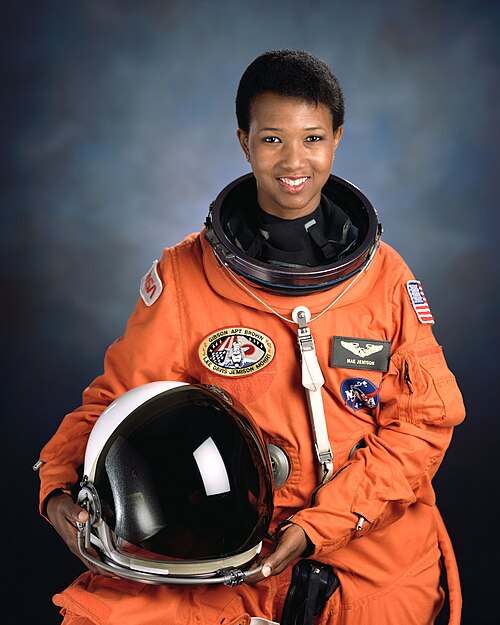
🌿 School Days: “Don’t You Mean a Nurse?”
In kindergarten, Mae Jemison’s teacher asked the whole class what they wanted to be when they grew up. “I want to be a scientist,” Jemison answered. Her teacher looked at her and said: “Don’t you mean a nurse?” There was no cruelty in it — nursing was simply the only science-adjacent future the teacher could picture for a little girl. But Jemison put her hands on her hips and answered back: “No, I mean a scientist.” She later explained why the correction didn’t stick: “I was excited about the world around me.” She grew up going hunting and fishing with her father, visiting Chicago’s Museum of Science and Industry and the Field Museum with her parents, and running an extended science experiment on pus after getting an infection — the kind of unglamorous, hands-on curiosity that never needed anyone’s permission.
That curiosity carried her all the way to Morgan Park High School in Chicago, where she graduated in 1973 at just 16 years old on a four-year National Achievement Scholarship — young enough that “Don’t you mean a nurse?” had already been answered several times over before she ever set foot on a college campus.
💗 A Lifelong Love Affair With the Stars
Jemison’s love for space wasn’t a passing phase — it was closer to certainty. She has said that growing up on the South Side of Chicago in the 1960s, she simply knew she would end up in space one day, not as a hope but as a fact waiting to happen. The spark had a specific source: watching Nichelle Nichols play Lieutenant Uhura on the original Star Trek. Jemison later described the show as one of science fiction’s most hopeful visions — a ship crewed by people from all over the world, including, in her words, “a woman of color in a technical role.” It told her, as she put it, that this was “something reasonable to think about.”
The connection was never just symbolic. Before her 1992 flight, Jemison personally called Nichols to thank her, one real astronaut reaching out to the actress who had made the idea feel possible in the first place. Once in orbit aboard Endeavour, she opened her communications every day on her shift with Uhura’s own signature line: “Hailing frequencies open.” And in 1993, only months after leaving NASA, Jemison appeared as Lieutenant Palmer in an episode of Star Trek: The Next Generation — becoming the first real astronaut ever to appear on the show, at the personal invitation of director LeVar Burton. Nichols visited her on set that day. Full circle, from a Chicago living room to the bridge of the Enterprise. ❤️
👖 What She Chose to Carry Into Orbit
Every astronaut is allotted a small personal kit for spaceflight. What Jemison packed into hers reads like a deliberate statement about whose history she was representing up there:
- A poster of dancer Judith Jamison performing “Cry” — an Alvin Ailey piece created as a tribute to Black women.
- A Bundu statuette, representing a women’s society in Sierra Leone, where she had served as a Peace Corps medical officer.
- A photograph of Bessie Coleman, the first African American to hold an international pilot’s license. Jemison later admitted she felt embarrassed she hadn’t learned about Coleman until her own spaceflight was on the horizon — and said she wished she’d known her growing up, “but then again I think she was there with me all the time.”
- A flag of Alpha Kappa Alpha, the oldest African American women’s sorority in the United States, of which she is an honorary member.
- A certificate on behalf of Chicago Public School students, encouraging them toward science and math.
None of this was required equipment. It was Jemison using eight days aboard Endeavour to carry a specific lineage — dance, aviation, sisterhood, and education — physically into orbit with her. 🧵
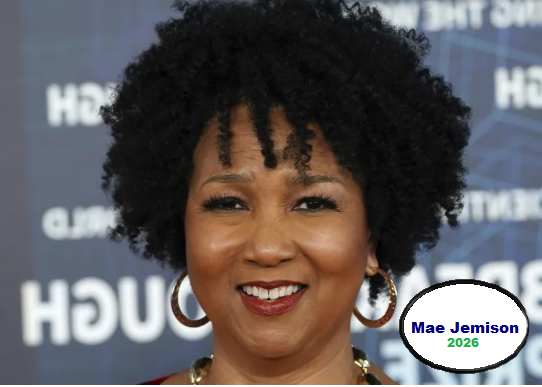
🧡 The Family Behind Her
Mae Carol Jemison was born October 17, 1956, in Decatur, Alabama, the youngest of three children of Charlie and Dorothy Jemison. The family moved to Chicago when she was three, part of the same Great Migration wave that reshaped so many Black American families in that era — her mother, unhappy with job opportunities in the South, sought a better future further north.
Charlie Jemison worked as a maintenance supervisor and carpenter. Dorothy Jemison taught English and math for more than 25 years at Ludwig van Beethoven Elementary School in Chicago — a career later honored directly in the name of Mae’s own nonprofit, the Dorothy Jemison Foundation for Excellence. An uncle encouraged her early curiosity about astronomy, anthropology, and archaeology. Her older sister, Ada Sue, also became a physician. Of her parents, Jemison later said simply: “My parents were the best scientists I knew, because they were always asking questions.” 👨👩👧
💃 The Career She Almost Chose Instead
At Stanford, Jemison led the Black Students Union and choreographed a full musical and dance production called “Out of the Shadows.” By her senior year, she faced a real fork in the road: medical school, or a professional dance career. She chose medicine — but never really let go of dance. During her years at Cornell Medical School, she kept training at the Alvin Ailey American Dance Theater, the same company whose “Cry” performance she later carried into orbit as a poster. Even her medical training took her far beyond a classroom: she traveled to Cuba for a study funded by the American Medical Student Association, worked in a Cambodian refugee camp in Thailand, and served with the Flying Doctors in East Africa — all before she’d even applied to NASA. 🩰
🌀 The Fear She Never Pretended Not to Have
Jemison has openly admitted she was afraid of heights — an unusual confession for someone whose job depended on strapping into a vehicle that leaves the atmosphere. Her own framing of it, given years later, was blunt: fear “is a weakness only if it keeps you from doing stuff.” She didn’t overcome the fear so much as decline to let it make the decision for her.
🔬 The Real Science Behind the Mission
STS-47, launched September 12, 1992, was a cooperative U.S.–Japan mission carrying the Spacelab-J module, with 44 life-science and materials-processing experiments running across eight days. Jemison served as science mission specialist and co-investigator on a bone cell research experiment conducted in microgravity — work with direct relevance to osteoporosis research on Earth. She logged 190 hours, 30 minutes, and 23 seconds in space, orbiting the planet 127 times.
Her scientific credibility didn’t begin at NASA. Before applying to the astronaut program, Jemison spent two and a half years as the Peace Corps’ area medical officer for Liberia and Sierra Leone, supervising a pharmacy, laboratory, and medical staff, writing self-care manuals, and conducting research with the CDC on a rabies program, on schistosomiasis, and on an early Hepatitis B vaccine. She holds a Stanford degree pairing chemical engineering with African and African-American studies, and is fluent in Russian, Japanese, and Swahili.
🌍 What “After NASA” Actually Looked Like
Jemison left NASA in March 1993 and immediately built in several directions at once, rather than settling into one legacy role. She founded the Jemison Group, a technology consulting firm, and the Dorothy Jemison Foundation for Excellence. In 1994, the foundation launched The Earth We Share, an international science camp for teenagers built around solving global problems collaboratively. She later became principal of 100 Year Starship, a DARPA-seeded initiative aimed at making human travel beyond the solar system feasible within a century. She has also consulted on science-fiction projects including National Geographic’s Mars series and Pixar’s Lightyear.
Read her full official biography on NASA’s official site.
Closing thought: Behind the “first Black woman in space” headline is a very specific person — a girl who refused a teacher’s correction, a Star Trek fan who called her hero before launch, a daughter of two working-class Chicago parents, a scientist who packed a dead aviator’s photograph into her flight suit. That specificity, more than the headline itself, is why her story keeps resurfacing more than three decades later.
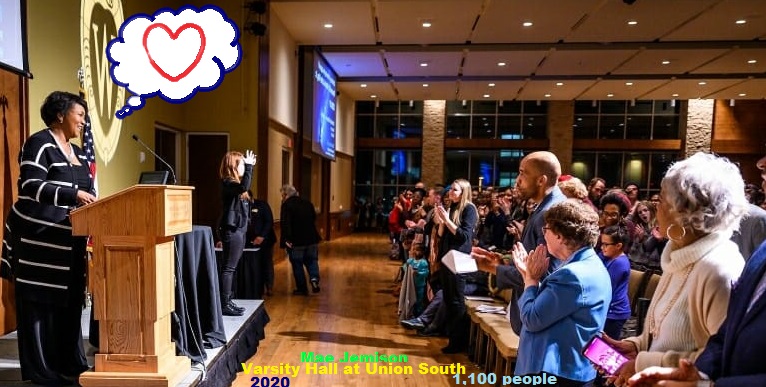
⭐ Words That Outlasted the Mission
Jemison’s most quoted line — “Never be limited by other people’s limited imaginations” — was chosen to appear on Google’s homepage Doodle for International Women’s Day on March 8, 2019, shown to hundreds of millions of people who searched that day. It’s a line that traces directly back to that kindergarten classroom, decades earlier: a teacher’s small assumption about what a Black girl could become, turned into a permanent public rebuttal.
Her cultural footprint kept expanding long after she left NASA, often in places far from a science classroom. She appeared as “Astronaut Mae” on Sesame Street, introducing a generation of preschoolers to space careers before they could read. In 2017, LEGO released its “Women of NASA” set, and Jemison became a minifigure alongside Sally Ride, Margaret Hamilton, and Nancy Grace Roman — a toy shelf standing in for a history lesson. In 2023, Forbes named her to its “50 Over 50” list, recognizing her ongoing work rather than treating 1992 as a closing chapter.
She has also made a habit of passing the torch forward in public, not just in interviews. When NASA announced in 2018 that Jeanette Epps would become the first Black woman to live aboard the International Space Station, Jemison was among the first to publicly congratulate her — one trailblazer marking the next one’s turn, more than 25 years after her own flight. It’s a small gesture, but a telling one: Jemison has spent as much energy pointing at who comes next as she has discussing her own record.
Sources: Wikipedia · African American Registry · AAE Speakers Bureau
🌊 Still at Work, Decades Later
Jemison never treated her spaceflight as a career peak to coast on. She is a member of the U.S. National Academy of Medicine, chairs the NASA Innovative Advanced Concepts External Council, and sits on the board of Kimberly-Clark, where she chairs the Sustainability Committee. She is a visiting scholar at Texas A&M’s EnMed program, working at the intersection of engineering, medicine, and science — the same combination she embodied on Endeavour thirty years earlier.
She still speaks openly about wanting to go back: “I’d love to go into space again if there were a mission to Mars. I’d also love to go to a completely different planetary system, out of our solar system.” At an age when most retired astronauts settle into memoirs and lecture circuits alone, Jemison is still actively steering the conversation about how humanity leaves the solar system at all.
Sources: NASA.gov · RIT News · University of Arkansas – Fort Smith
🐾 The Small Stuff Nobody Puts in the Headlines
Long before Stanford, before NASA, before any of the “firsts,” Jemison was a kid who ran to school in third grade so she wouldn’t miss watching NASA’s Gemini launches on television. Science and dance competed for her attention from the start: she took ballet and modern dance lessons, and when no one could drive her to class, she took the train alone rather than skip it. At 14, she auditioned for the lead role of Maria in a school production of West Side Story. She didn’t get the part — she was cast as a background dancer instead. It’s a small, ordinary rejection, the kind most successful people quietly erase from their own story. Jemison never did; she mentioned it herself, years later, as part of how she talks about her path.
That tension between science and dance followed her all the way through medical school. At Cornell, while her classmates spent free time resting, Jemison spent her limited money and hours at the Alvin Ailey American Dance Theater — the same company whose “Cry” poster she later carried into space. She was also, in her own words, uncomfortable at first working with cadavers in anatomy class, a detail rarely mentioned next to “first Black woman in space,” but a very human one: even she had to get used to parts of the job.
Her personal life has stayed simple by design. Jemison has never married and has no children, and she’s never treated that as something to explain or apologize for. She lives in Houston with two cats — named Sneeze and Little Mama — and lists sewing, skiing, photography, and language study among her actual hobbies outside of work. She’s fluent in Russian, Japanese, and Swahili, not for any single professional reason, but because, by her own account, she simply likes learning them.
And her scientific work didn’t end with 100 Year Starship. Jemison also runs BioSentient Corp, a medical technology company developing wearable sensors that monitor the body’s autonomic nervous system — heart rate, stress response, physical strain, tracked in real time outside a hospital setting. It’s a project that quietly connects three separate chapters of her life: the Peace Corps doctor who once wrote self-care manuals in Sierra Leone, the astronaut who co-investigated bone loss in microgravity, and the engineer who never stopped building things after the headlines faded.
Sources: NASA.gov · National Library of Medicine · Wikipedia · Biography.com
Related Trailblazer
Do You Know Viola Desmond? Information & Amazing AI Scenes →Another Black Canadian and American trailblazer who challenged the limits placed on her, decades before Jemison’s own fight against low expectations.
🎯 Final Thought
Thirty-four years after Endeavour lifted off, Mae Jemison’s story keeps resisting the flattened version people default to. Not just “first Black woman in space,” but a kid who ran to school for rocket launches, a dancer who nearly chose the stage over medicine, a doctor who wrote self-care manuals in Sierra Leone, and someone who still, today, chairs research councils and runs a medical technology company in Houston. The headline made her famous. The specifics are what make her worth remembering in detail — and why her name keeps resurfacing in searches more than three decades later.
📚 Resources & Further Reading
This article draws on official NASA records and reputable historical, medical, and biographical archives:
- NASA.gov — Official Biography
- NASA.gov — Former Astronaut Mae C. Jemison
- NASA.gov — Official Mission Photo Archive
- National Library of Medicine — Changing the Face of Medicine
- Wikipedia — Mae Jemison
- Biography.com
- Encyclopaedia Britannica
- Smithsonian National Air and Space Museum
- African American Registry